Precision Voltage String - Part 2
How Sensitive is V1 to a 1% Change in R2?
CIRCUIT
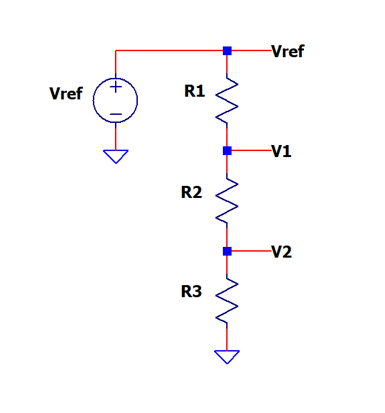
Part 1 - intro to precision voltages using a resistor divider.
Part 2 - how accurate are these voltages?
Part 3 - two cool design methods using advanced Excel functions.
For precision designs, you'll need to answer the following: how Sensitive are the Voltage levels to the Resistor tolerances? Let’s walk through finding the Sensitivity of V1 to a 1% change R2. You’ll see the two methods in action
SENSITIVITY
Simply stated, Sensitivity S indicates a how a specific circuit characteristic will change for a given component change.
For example, if you calculated S = 0.5 for a voltage change versus a resistor change, then selecting a 1% resistance change would cause a voltage change of 1% x 0.5 = 0.5%.
Difference Method
This method calculates the sensitivity of a circuit characteristic y=f(x) using a small increment of a component Δx. Using normalized ratios
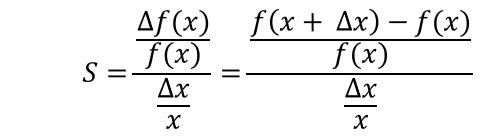
Note that no new function is needed, only the original f(x). The
method provides an approximate value of S.
Derivative Method
The Derivative Method calculates the instantaneous sensitivity of y=f(x) as the interval Δx approaches 0.

Notice, this method introduces a new function - the partial
derivative! You can find partial derivatives by applying various rules of
calculus (Chain, Product, Power, etc.) This analysis provides an accurate
value of S.
VOLTAGE DIVIDER STRING
This classic circuit generates a string of voltages using a resistor divider with real-world applications: internal diagnostics, self-calibration, comparator levels, level shifting, etc.
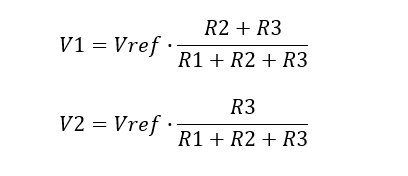
EXAMPLE
Suppose your circuit has the following components.
- Vref = 5V, R1 = 1k, R2 = 8k, R3 = 1k
Calculate the two voltage levels.
- V1 = 5V x 9k/10k = 4.5V
- V2 = 5V x 1k/10k = 0.5V
DERIVATIVE METHOD
Three steps get you to the Sensitivity S of V1 to R2.
- Write the original function
- Derive partial derivative function using rules: Chain, Product, Powers, etc.
- Calculate S and simplify
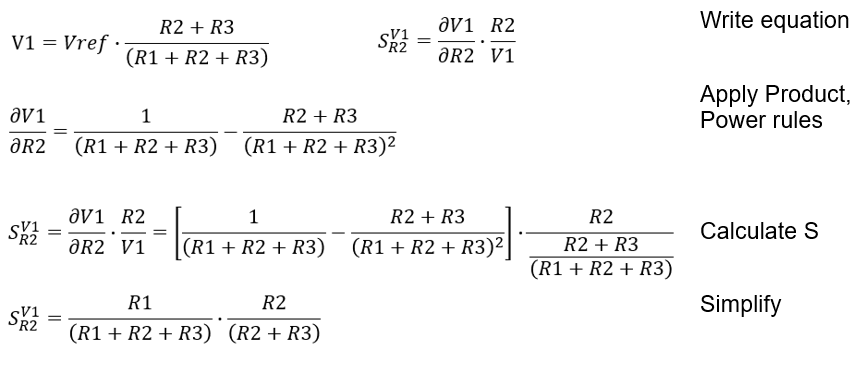
For R1=1k, R2=8k, R3=1k, Vref=5V we get
S = 0.08889
What is S telling us? A 1% resistance change in R2 would cause a V1 change of
Verror = R2tol x S = 1% x 0.09 = 0.09%
Notice, the Derivative Method required a bit of math effort - even for a simple circuit as this! While it was challenging and fun, the equations could get unwieldy for larger more complex circuits. (BTW, my math skills needed some refreshing for this design adventure.)
Also notice, the error is far less initially expected! In this case, the R2’s 1% change on V1 is only 0.09%. The lesson here? It’s worth doing the math to find S, especially in high precision designs! But note, the sensitivities in general can range from -1 to +1 depending on the topology.
Now, let’s see how the Difference Method compares in regard to both effort and accuracy.
DIFFERENCE METHOD
Three steps to find S
- Write the original function.
- Copy the function and increment x.
- Calculate S
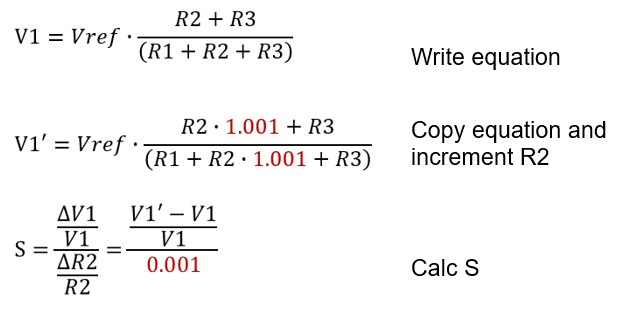
As an example, we’ll find the Sensitivity of V1 to R2.
For R1=1k, R2 = 8k, R3=1k, Vref = 5V and an R2 increment of 0.001, we get

Notice that S computes fast and easy. Creating these equations in Excel or other calculator tools can be relatively straightforward.
More good news, the Difference method closely approximates the Derivative Method's result of S = 0.08889. (An increment of 0.0001 or less, gets you even closer.)
THE BIG PICTURE
What are the Sensitivities and Errors for all resistors on V1 and V2? Check out the columns of the Sensitivity (S) and Error (Verror=Tol*S) for both voltages V1 and V2. All component Tolerances for R1-R3 and Vref are 1%.
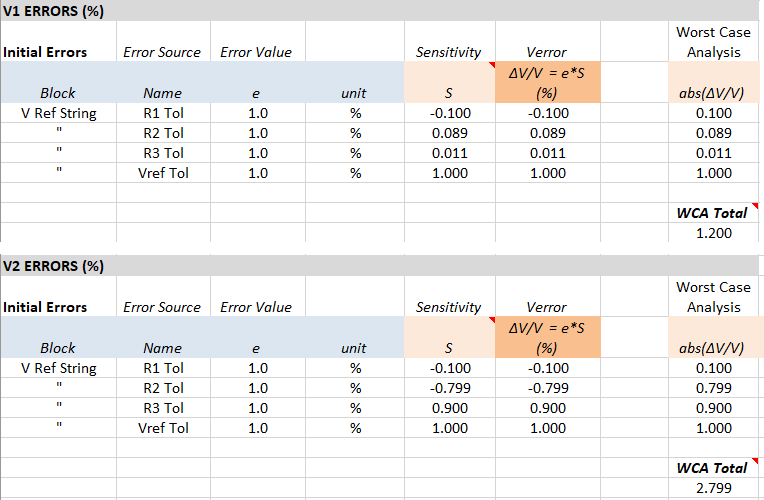
Notice how the Sensitivity of R2 on V1 is only S=0.09 while the same resistor on V2 is a whopping S=-0.799! Why? As a general rule, the greater the Reduction of Vref, the greater the Sensitivity. Conversely, a smaller reduction in voltage, a smaller sensitivity.
SENSITIVITY RECAP
Derivative Method
- An accurate calculation of S
- May require significant math effort to find S
- Equations may get daunting for more complex circuits
- Prone to errors, difficult to review
Difference Method
- An approximate calculation of S
- No new equations, simpler calculation
- Quicker, easy to review
What do you think? Any other advantages or disadvantages for each
method?
Let me know your thoughts and comments!
EXCEL CALCULATOR
Download the Error Budget Analysis calculator voltage-divider-string-errors-1.xlsx.
- Enter: Vref,R1,R2,R3
- Calc: Component Sensitivities, Voltage Errors
- Experiment, change values, predict what happens!